
Published
The Bottom Line
- —Botox blocks the nerve signal (acetylcholine) that tells a muscle to contract.
- —It targets the specific muscle it's injected into. Nearby muscles keep working normally.
- —Most people rate the injection 1 to 4 out of 10 on a pain scale, more like a quick pinch than a deep injection.
- —Onset usually occurs between days 3 to 5, with full effects setting in by days 10 to 14.
- —It doesn’t "freeze" your whole face. Its effects only target muscles being treated.
How Does Botox Work in the Body?
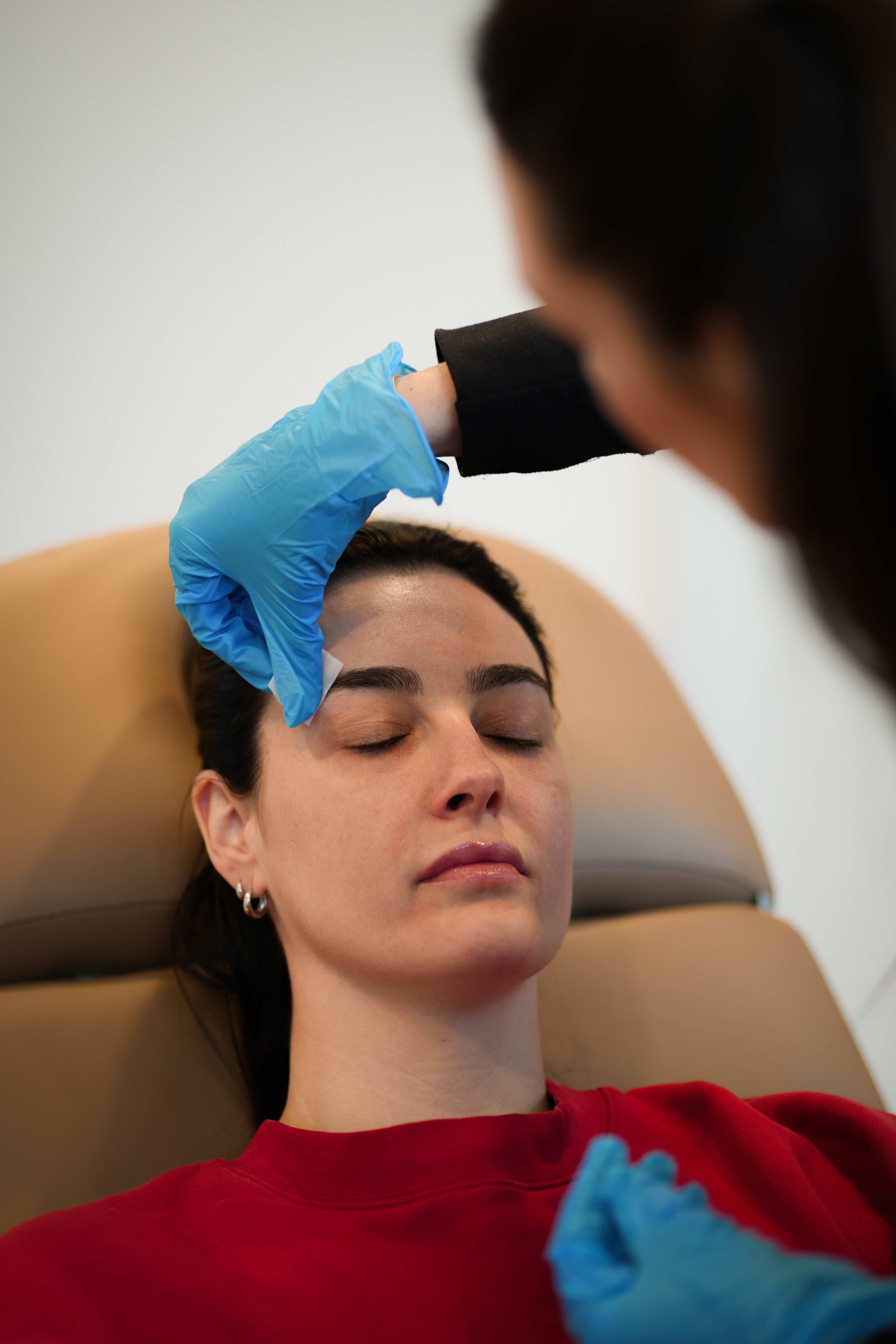
A Botox injection is quick, often taking only a few seconds. What happens after the first pinch is a much more deliberate process than most patients picture, and it’s worth understanding before you sit in the chair.
You feel a quick poke in a handful of spots, then go about your day. Underneath the skin, something much more precise is happening at a cellular level where the medication acts locally to reduce nerve signals that trigger muscle contraction.
So how does Botox work? It blocks a chemical signal at a specific point in the body: the spot where a nerve ending meets the muscle it controls. If you’re still working out what’s actually in the syringe, start with the basics, so you get a good grip on what Botox is made of. This piece focuses purely on the mechanism.
Botox doesn’t circulate through your body, turning off muscles at random; it stays close to the injection site and interrupts one signal, in one spot, for one muscle.
The neuromuscular junction is a tiny gap, measured in nanometers, and it’s the only place this whole process happens. Everywhere else along that nerve, signals keep transmitting normally. That’s why a forehead injection has no direct effect on your jaw, your eyelids blinking, or a muscle two inches away that wasn’t treated. Reviews of botulinum toxin’s mechanism at the neuromuscular junction describe this same site-specific action as the reason the effect stays contained to the treated muscle rather than spreading.
It also explains why touch-ups get injected in or around the same areas as the original treatment, not just somewhere nearby in the same general region. The nerve endings feeding a specific muscle are generally consistent from visit to visit, so an injector working from your history knows where the last treatment landed and adjusts from there.
The Nerve-Muscle Signal, Step by Step
- —A nerve releases acetylcholine at the neuromuscular junction, the point where a nerve meets a muscle.
- —Acetylcholine binds to receptors on the muscle fiber, telling it to contract.
- —Botox blocks the release of acetylcholine at the injection site, preventing the signal from reaching the muscle.
- —The targeted muscle can't contract as forcefully. Nearby, uninjected muscles keep working as they did before.
That last point is where a lot of the fear around Botox comes from, and it’s usually based on a wrong assumption. People picture the toxin spreading across the face and shutting everything down at once. In reality, its effects are localized, which is exactly why a skilled injector can raise one eyebrow’s mobility while softening another area entirely.
This is also why dosing, placement and injection depth matter more than most patients realize. Too much product, or a needle placed slightly off target, can contribute to the heavy, immobile look people associate with “bad Botox.” The mechanism itself is precise; the outcome depends on how the treatment is planned and administered.
What Does Botox Do to Your Face?
Botox reduces the strength and frequency of a specific muscle’s contraction, and the visible effect depends on which muscle gets treated. It’s not one uniform effect applied to the whole face; it’s a series of individual, targeted adjustments.
“Weakened” is the more accurate word than “paralyzed,” even though the second one gets used constantly in casual conversation. A properly dosed muscle can usually still move, just with noticeably less force, which allows a treated forehead to still show some expression instead of sitting completely still.
Muscle-by-Muscle Breakdown
| Area | Muscle | What You'll Notice |
|---|---|---|
| Forehead | Frontalis | Reduced ability to raise eyebrows, smoother horizontal lines |
| Frown lines (11s) | Corrugator / Procerus | Less ability to furrow the brow, softer vertical lines |
| Crow's feet | Orbicularis oculi | Reduced squint lines at the outer eye corners |
Each of these muscles does a specific job, and Botox only interferes with the muscle’s ability to perform it. The frontalis raises your eyebrows. The corrugator and procerus pull your brows together into a frown. The orbicularis oculi is the ring muscle around your eye that creates a squint.
Treat the frontalis and your forehead stops creasing as much when you raise your eyebrows, but your smile, your blink, and your ability to talk stay untouched. This is the muscle-by-muscle logic every good injector works from, even when a patient just says “I want my forehead lines gone.”
This is also why two patients with similar-looking forehead lines can need different treatment plans. One person’s lines might come mostly from the frontalis, someone else’s from a stronger corrugator pulling the brow down, and the muscle doing the most work helps determine where the product actually goes.
Beyond these three, injectors sometimes treat smaller muscles like the ones causing bunny lines on the nose or vertical neck bands, using the same nerve-blocking mechanism at a lower dose. Basic muscle biology doesn’t change; only the dose and injection points vary from muscle to muscle.
What Botox Does Not Do
It doesn’t add volume anywhere on the face. If your concern is hollowing under the eyes or thinning lips, that’s a filler conversation, not a Botox one, and injecting toxin into a volume problem won’t fix it. If a different concern is actually driving what you’re seeing, it’s worth browsing our full range of services before committing to a specific injectable.
It doesn’t tighten skin. Botox relaxes a muscle underneath the skin; it has no direct effect on skin elasticity, texture, or laxity. And it doesn’t directly address aging happening elsewhere on your face or body. Treating your forehead does not affect your neck, your hands, or anywhere else you might be noticing changes.
These distinctions matter because Botox is a targeted treatment and is not a solution for every visible sign of aging. Knowing what it can and cannot change helps set realistic expectations before you go in for the procedure.
Additionally, Botox doesn’t stop the underlying aging process. Muscles you haven’t treated keep moving, sun exposure continues, and collagen declines with age regardless of how many areas you’ve had injected. Botox pauses one specific mechanical cause of lines; it doesn’t pause time.
A little soreness at the injection sites for a day, similar to a mild bruise, can be normal and expected. It’s a separate thing from the mechanism itself and just reflects the needle passing through skin, not the toxin doing anything unusual.
Does Botox Hurt?
For most patients, the discomfort with getting Botox is mild. Most patients rate it between a 1 to 4 out of 10, which puts it closer to a light pinch than an actual painful injection.
Pain by Treatment Area
| Area | Pain Level (1–10) | What It Feels Like |
|---|---|---|
| Forehead | 2–4 | Light tap or pinch |
| Glabella (11s) | 2–4 | Brief pressure between the brows |
| Crow's feet | 1–4 | Slightly sharper pinch, thin skin |
Part of why it’s so mild comes from the way Botox is injected. Botox is typically delivered with 30- to 34-gauge needles, which are very fine and only need to reach the muscle layer rather than going deep.
If you tend to avoid appointments because of needle anxiety, it can help to know that Botox injections are milder than the anticipation makes them seem. Most first-time patients report an easier experience than expected, and most treatment areas are usually done before the anxiety even has time to build.
Compare that to a flu shot, which uses a wider needle and injects a larger volume deeper into muscle tissue. Botox injections are shallower, use less volume per injection point, and are spread across several very quick pokes instead of one longer one. That combination is why the discomfort is mild for most people, including those who dread needles in general.
Some areas do feel a little sharper than others, and that’s partly related to nerve density and sensitivity of the area. Crow’s feet sit over thin skin packed with sensory nerve endings, so a pinch there registers slightly more than the same-sized pinch on the forehead.
How Long Until You See Results?
Onset starts around day 3 to 5, and the effect is fully settled by day 10 to 14. That timeline can vary depending on the individual and the area being treated.
The reason it fades a few months later comes straight from the same mechanism: nerve endings naturally regenerate over time, sprouting new connections to the muscle that eventually restore normal signaling. Botox doesn’t damage the nerve permanently. It temporarily interrupts one connection point until normal signalling returns.
FAQs
Does Botox hurt?
No. Most patients rate it 1 to 3 out of 10 on a pain scale, which feels like a quick pinch rather than a deep or painful injection.
What does Botox do to your face?
It reduces the strength and frequency of contraction in the specific muscle it's injected into, which softens the lines that muscle's movement was creating. Untreated muscles nearby keep working normally.
How long does it take Botox to start working?
Onset begins around day 3 to 5, with the full effect visible by day 10 to 14.
Can you still move your face normally after Botox?
Yes. Only the treated muscle's strength is reduced. Every other muscle, including the ones controlling your smile, blink, and speech, keeps working exactly as it did before treatment.
Is the pain different for first-timers vs. repeat patients?
Not meaningfully. The needle and technique are the same either way, though repeat patients often report feeling more relaxed simply because they know what to expect and how quickly it's over.
Ready to Talk Through Your Treatment Areas
Understanding the mechanism is one thing. Knowing which muscles are actually driving your specific lines is a different question, and it’s one an injector needs to see your face to answer properly.
No two faces recruit the same muscles at the same strength, which is exactly why a mechanism-first approach beats a one-size-fits-all injection pattern. The muscle causing your particular line is the thing worth mapping out before anyone picks up a syringe.
Book a free consultationand we’ll walk through which areas make sense for you, using the same Botox, Dysport & Xeominoptions covered on our injectables page. That’s the approach we take with every patient who visits our West Des Moines med spa or our Clive location: treat the muscle that’s actually causing the line, not just the area you’re pointing at.