Published
The Short Answer
- —Botox is a prescription brand of onabotulinumtoxinA, a purified botulinum toxin type A protein manufactured under controlled conditions.
- —The vial contains three listed ingredients: onabotulinumtoxinA, human albumin, and sodium chloride. A provider reconstitutes the powder with sterile saline before injection.
- —Botox temporarily reduces muscle activity by blocking the release of acetylcholine, the chemical signal a nerve uses to tell a muscle to contract.
- —Cosmetic results usually begin to appear within 3–7 days and are best assessed at about two weeks. Effects commonly last around 3–4 months.
- —Botox has FDA-approved cosmetic and medical uses. Other botulinum toxin type A brands include Dysport, Xeomin, and Jeuveau.
What Is Botox, Exactly?
Botox is not a vial of “poison” being casually injected into your face. That framing takes a real biological fact—the medicine is derived from botulinum toxin type A—and strips away the part that matters: it is a purified, precisely dosed prescription product manufactured under controlled conditions and placed in specific muscles by trained medical professionals.
So, what is Botox? Botox is the brand name for onabotulinumtoxinA, a neuromodulator that temporarily reduces the nerve signal telling a targeted muscle to contract. When that muscle cannot pull as strongly or as repeatedly, the skin above it creases less. Dynamic lines such as forehead lines, frown lines, and crow’s feet can therefore look smoother while the medicine is active.
The wording gets confusing because “Botox” is often used as shorthand for the entire treatment category, much like people use a brand name for a general product. Technically, Botox is one brand. Dysport, Xeomin, and Jeuveau are other botulinum toxin type A neuromodulators. Each has its own formulation, approved labeling, and dosing.
If you have ever typed “what’s Botox?” into a search bar and found answers that jump between a brand, a toxin, and a cosmetic procedure, that is why. Botox can refer to the branded medicine, while “neuromodulator treatment” describes the broader category of injections used to reduce selected muscle activity.
What Is Botox Made Of?
Botox is made with onabotulinumtoxinA as the active ingredient, plus human albumin and sodium chloride as inactive ingredients. The product is supplied as a sterile, vacuum-dried powder and is mixed with sterile saline before treatment.
The Three Ingredients
| Ingredient | Function | Source or Role |
|---|---|---|
| OnabotulinumtoxinA (botulinum toxin type A) | The active ingredient. It temporarily inhibits acetylcholine release at the treated nerve ending, reducing contraction of the targeted muscle. | A purified neurotoxin protein produced from Clostridium botulinum type A under controlled manufacturing conditions. |
| Human albumin | Stabilizes the medicine during manufacturing and storage. | A highly purified human plasma protein used as an excipient in many medical products. |
| Sodium chloride | Supports the formulation; sterile saline is also used to reconstitute the powder before injection. | Standard salt used in medical saline solutions. |
That is the full ingredient list in the FDA prescribing information for Botox and Botox Cosmetic. The vial does not contain filler, silicone, collagen, or snake venom. It also does not add physical volume to the face.
Is Botox Made From Snake Venom?
No. Botox is not made from snake venom. Its active ingredient is onabotulinumtoxinA, a purified form of botulinum toxin type A derived from the bacterium Clostridium botulinum. Snake venom and botulinum toxin are unrelated substances, despite the internet’s fondness for grouping anything that affects nerves into one dramatic myth.
Botox is also only one option within the neuromodulator category. Aesthetic Collective offers Botox, Dysport, and Xeomin and recommends a product and dosing plan based on your anatomy, goals, prior response, and treatment area.
How Does Botox Work?
Every voluntary facial expression begins with a nerve signal. A nerve releases a chemical messenger called acetylcholine at the point where the nerve and muscle communicate. Acetylcholine binds to the muscle and tells it to contract. Botox interrupts that message at the treated nerve ending.
The Mechanism, Step by Step
- —A motor nerve prepares to tell a facial muscle to contract.
- —The nerve would normally release acetylcholine into the small gap between the nerve ending and the muscle fiber.
- —Botox enters the local nerve ending and blocks the machinery required to release acetylcholine.
- —With less acetylcholine reaching the targeted muscle, that muscle contracts less forcefully and less often.
- —The skin above the muscle folds less repeatedly, so movement-related lines soften while the effect is active.
This is a local treatment, not a whole-face shutdown. The injector places small doses into selected muscles. Uninjected muscles continue working, and even treated muscles are usually weakened rather than rendered completely motionless. Dose, placement, muscle strength, and treatment goals determine how much movement remains.
Botox has been FDA-approved for cosmetic use since 2002, starting with the frown lines between the eyebrows. At the cellular level, it works by blocking the release of acetylcholine at the nerve ending, which is the specific step that stops the muscle from getting the signal to contract.
Why Does a Wrinkle Look Smoother?
Botox does not erase a line by filling it from underneath. It changes the repeated movement creating or deepening the crease. Imagine folding the same piece of paper along one line hundreds of times: the fold becomes increasingly visible. Reduce the folding, and the line looks softer. That is the basic relationship between muscle relaxation and smoother skin.
Dynamic lines—the ones you see mainly when raising your brows, frowning, or squinting—usually respond most predictably. Static lines that remain visible when the face is fully relaxed may soften but not disappear completely, particularly if they are deeply etched or accompanied by sun damage and collagen loss. Those concerns may require a combined plan involving skincare, resurfacing, or other treatments.
Will Botox Freeze Your Face?
Not automatically. A frozen look is usually a dosing and placement choice, not an unavoidable property of the medicine. Botox only affects the muscles it reaches, and treatment can be planned to soften movement rather than eliminate it. Someone with strong forehead muscles who wants maximum line reduction may choose a different balance than someone who wants every eyebrow expression preserved. For more insights, check our deep dive on how Botox works.
The trade-off is real: more movement generally means more visible dynamic lines, while stronger relaxation can create a smoother result with less expression. A good consultation makes that preference explicit instead of assuming everyone wants the same finish. Aesthetic Collective’s stated approach is conservative dosing and natural movement, so the goal is refreshed rather than mask-like.
What Botox Does Not Do
- —It does not add volume. Hollow temples, flat cheeks, or thin lips are volume concerns, not muscle-activity concerns.
- —It does not physically tighten loose skin or replace a surgical lift.
- —It does not erase every static line immediately. Deep creases may improve gradually or need complementary skin treatments.
- —It does not stop aging in untreated areas, and the effect is temporary.
- —It should not be used to copy a fixed unit chart without assessing the person in front of the injector.
This is why an accurate diagnosis of the concern matters. Treating volume loss with more neuromodulator can make the face look flatter; treating a movement-driven line with filler alone can add bulk without addressing the cause. The most natural plans match the tool to the anatomy.
What Areas Does Botox Treat?
For cosmetic treatment, Botox is commonly used to soften forehead lines, glabellar frown lines between the brows, and crow’s feet around the eyes. Depending on a patient’s anatomy and a provider’s assessment, neuromodulators may also be used in other facial or neck areas, sometimes off-label. Medical botulinum toxin treatment can address conditions such as chronic migraine, severe underarm sweating, certain muscle spasms, and overactive bladder. Jaw-clenching or masseter treatment is common in aesthetics but is generally considered an off-label use rather than an FDA-approved cosmetic indication.
Treatment is muscle-specific, so the assessment matters. You can check out the broader list of services we offer in West Des Moines and discuss whether the concern is caused by muscle activity, volume loss, skin texture, or a combination of factors.
What to Expect: Botox Timeline, Cosmetic vs. Medical Uses
Cosmetic vs. Medical Botox
Cosmetic Botox uses carefully selected doses to reduce the muscle activity associated with expression lines. Medical Botox uses the same active ingredient, but the treatment patterns and doses may be very different. For example, chronic migraine treatment follows an established injection protocol across multiple head and neck sites; hyperhidrosis treatment targets sweat-gland signaling; and spasticity treatment focuses on overactive muscles affecting movement or posture.
This distinction matters because a cosmetic forehead appointment does not expose you to the same dose or injection pattern as a medical treatment for a neurologic condition. It also explains why internet comparisons of “how many units” can be misleading without the treatment area, brand, anatomy, and indication.
Your Results Timeline
| Timeframe | What Happens | What You May Notice |
|---|---|---|
| Day 0 | The medicine is injected into selected muscles. Small bumps, redness, or pinprick marks may appear briefly. | Most people return to normal daily activities immediately, following the provider's aftercare instructions. |
| Days 3–7 | The effect begins as acetylcholine release is reduced at the treated nerve endings. | Movement starts to feel softer; lines may begin to look less pronounced. Some people notice change earlier or later. |
| Days 10–14 | The cosmetic effect is usually close to its peak and most useful for assessment. | The treated area looks smoother, and any planned review can evaluate balance and remaining movement. |
| Months 3–4 | Nerve signaling gradually recovers and muscle activity returns. | The result fades rather than switching off overnight. Maintenance timing is personalized. |
When does Botox start working? Most people notice the beginning of an effect within about 3–7 days, with the clearest result by roughly two weeks. The onset can vary by product, dose, muscle strength, and individual biology.
How long does Botox last? Cosmetic results commonly last about 3–4 months. Some first-time patients notice movement returning sooner; others maintain an effect longer. Regular treatment may change the pattern over time, but no responsible provider can guarantee an exact duration for every person.
What the Appointment Actually Feels Like
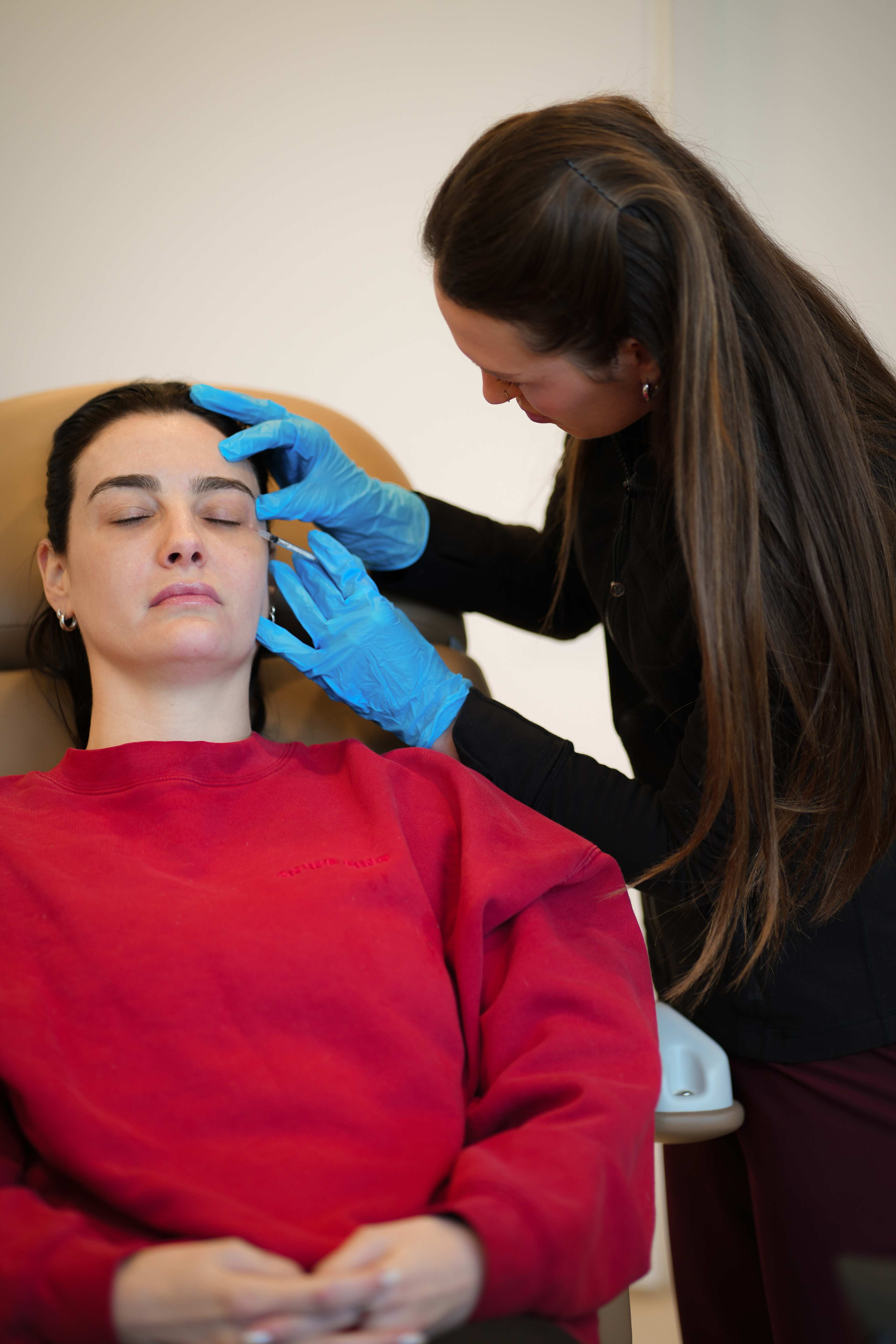
Here is the blunt version: Botox injections feel like several tiny, quick pinches. They are not completely sensation-free, but they are also not comparable to a deep vaccine injection or filler placed into the lips. The needle is very fine, the amount at each point is small, and each injection takes only a moment.
Some areas sting more than others. The skin near the eyes may feel sharper; the forehead often feels like a quick tap or mosquito bite. You may hear a faint crunching sound as the needle passes through the skin, which can be strange the first time but is not a sign that anything is wrong.
If needles make you anxious, say so before treatment. You can lie back, take breaks, avoid watching the setup, and use a cold pack when appropriate. A ten- to fifteen-minute appointment is not a character test. There is no prize for pretending you are relaxed when you are not.
Is Botox Safe?
Botox is considered safe when administered by a licensed provider, and significant new safety concerns haven’t emerged even at the higher doses used for medical indications like migraines and hyperhidrosis. The risk profile depends on the indication, dose, injection site, underlying health, and provider technique.
Common cosmetic effects include brief pain, redness, swelling, or bruising at an injection point. Some people experience a mild headache. Temporary asymmetry, a heavy brow, or eyelid drooping can occur if the effect reaches a muscle that was not meant to be weakened or if the treatment changes the balance between neighboring muscles.
Rarely, botulinum toxin effects can spread beyond the injection area and cause more serious symptoms. The Mayo Clinic safety overview advises seeking urgent medical care for symptoms such as widespread muscle weakness, trouble speaking or swallowing, breathing difficulty, vision problems, or an allergic reaction.
The honest safety conversation is not “Botox is dangerous” versus “Botox is harmless.” It is a prescription treatment with real benefits, common minor effects, uncommon technique-related problems, and rare serious risks. Good care reduces risk through appropriate screening, authentic product, accurate anatomy, conservative dosing, and clear follow-up instructions.
Tell your provider about neurologic or muscular disorders, swallowing or breathing problems, prior facial surgery, allergies, current medications, recent antibiotics, previous botulinum toxin treatment, pregnancy or breastfeeding, and any infection or inflammation near the proposed injection site. Treatment may need to be delayed or avoided depending on your circumstances.
Botox, Dysport & Xeomin: What Is the Difference?
All three are botulinum toxin type A neuromodulators, but they are separate prescription products. Botox contains onabotulinumtoxinA; Dysport contains abobotulinumtoxinA; and Xeomin contains incobotulinumtoxinA. Their formulations, diffusion behavior, onset patterns, approved indications, and dosing units differ.
No brand is universally “stronger” or best for every face. A provider may prefer one for a particular treatment pattern, prior response, desired onset, or patient preference. The important point is that units are product-specific. Thirty units of one brand are not automatically equivalent to thirty units of another.
Frequently Asked Questions
What's actually in a Botox vial?
Three ingredients: botulinum toxin type A, human albumin, and sodium chloride. There's nothing else in the formula — no filler compounds, preservatives, or added chemicals.
How long do Botox results typically last?
Most patients get 3 to 4 months of visible results before the treated muscle gradually regains its normal activity. Some people metabolize it faster and see it fade closer to 10 to 11 weeks, especially early on before muscle memory develops.
Does Botox have a good safety track record?
Yes. It's been FDA-approved since 2002 for cosmetic use, and decades of both cosmetic and medical use haven't turned up significant new safety concerns at standard doses. The bigger safety variable is provider skill, not the drug itself.
Are Dysport and Xeomin just Botox under a different name?
No. They're different brands of botulinum toxin type A with their own dosing units, formulations, and stabilizers, not repackaged Botox. Units don't convert 1:1 between brands, which is why your injector picks a dose based on the specific product being used.
What does getting Botox actually feel like?
A series of quick pinches, done in under two minutes per treatment area, with no real downtime afterward. Most patients rate it as more tolerable than they expected going in.
Ready to See What It Looks Like on You
If you’ve read this far, you already know more about what’s in the syringe than most people who walk into a consult. The only thing left is finding out how your own face responds to it, and that’s not something an article can tell you.
If price is part of what’s holding you back, we’ve broken down what Botox actually costs here in Des Moines separately, so you’re not guessing at that either.
Book a free consultationand we’ll map out exactly which areas make sense for you before anything gets injected. That’s how we do things at our West Des Moines med spa. No upsells, just a plan built around your face.